
← News & Research
Press
Korean Society of Digital Health Advances Research on "A Healthy Future Opened by Nature and Digital Technology"
September 5, 2025
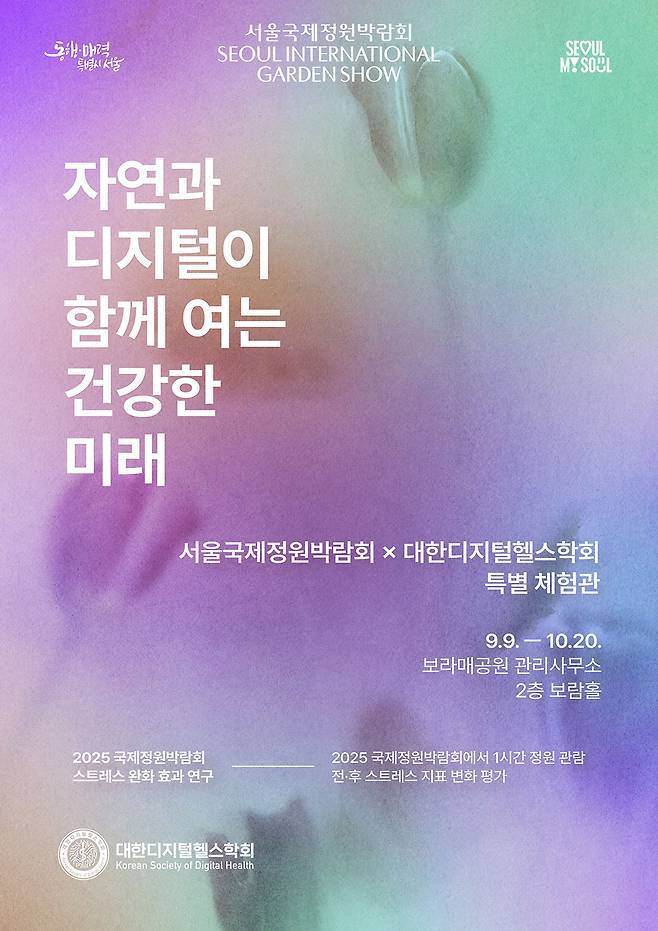
Seoul faces a complex set of challenges — the transition to a super-aged society, the climate crisis, and mental health issues. In the face of these challenges, an unlikely pairing — "gardens" and "digital health" — is set to come together in a new attempt to offer solutions.
The Korean Society of Digital Health (KSDH) announced on the 5th that, in connection with the "2025 Seoul International Garden Fair," running from the 9th through October 20 at Boramae Park in Seoul, it will operate an experience pavilion under the theme "A Healthy Future Opened Together by Nature and Digital Technology," while conducting foundational research to quantify the stress-relief effects of garden exposure.
Gardens have long served not merely as landscaped spaces but as public health resources supporting people's physical and mental recovery. Programs such as Thrive in the UK and Park Rx America in the United States have demonstrated that garden and green spaces are effective in reducing stress hormones, stabilizing blood pressure, and easing depression and anxiety.
This special experience pavilion is designed to compare and observe participants' biometric data before and after visiting the garden using advanced devices. A range of digital health services will be used, including a wearable ECG device (Hicardi by Medge), a smart ring (Chita Ring by BREDIS Healthcare), a multi-channel oral irrigator (Comoral by SMD Solution), salivary cortisol measurement (Kells), a smart urine test (Cym702 by Yellosis), and a personalized health management app (LiteracyM by K-BioHealthcare).
The collected biometric data will be analyzed using AI and provided to participants, allowing them to directly observe changes in stress-related biosignals before and after touring the garden — offering a visual, firsthand experience of "what changes nature brings to the body and mind."
Through this pilot program, the Korean Society of Digital Health expects a range of multi-layered outcomes, including: establishing scientific evidence on the effects of garden exposure on stress and oral health; developing AI-based personalized healthcare algorithms; producing research papers and patents; and strengthening ties with the digital health policies of the Seoul Metropolitan Government and the Ministry of Health and Welfare.
"Joint algorithm development based on pilot data, results presentations, policy engagement opportunities, and exhibition exposure could serve as a springboard for expanding the digital health industry ecosystem," said a KSDH official.